Handheld vs Portable Second-Generation Laser Marking Machines
News Details
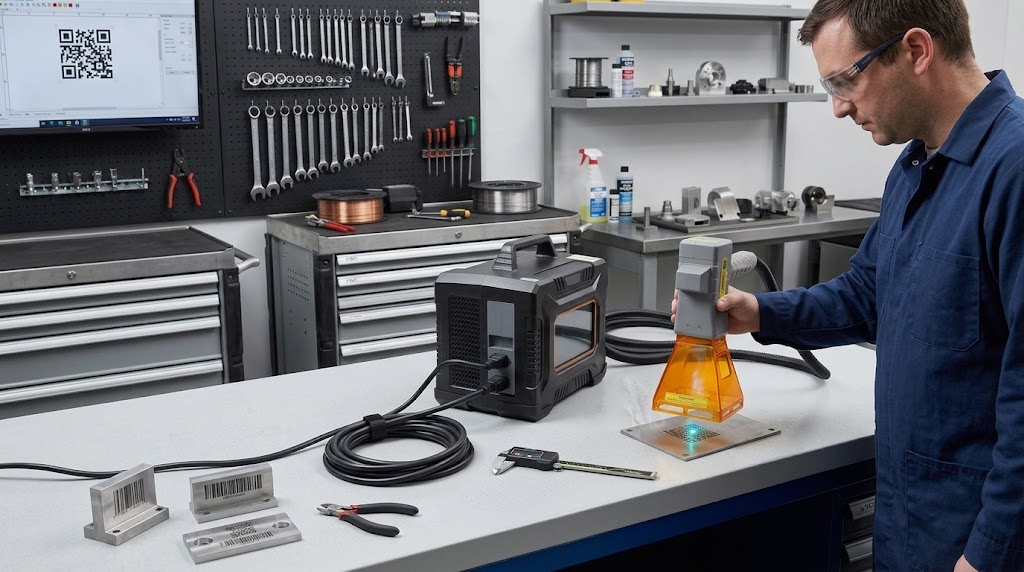
Choosing the right laser marking machine is not only about laser power or marking speed. For many industrial buyers, mobility is just as important. A machine may need to mark large parts, installed equipment, pipes, metal structures, or components that are difficult to move.
This is where handheld and portable laser marking machines become useful. However, not all portable systems offer the same level of flexibility.
A traditional handheld laser marker usually focuses on moving the marking head to the workpiece. A newer second-generation portable design goes further by combining a compact body, built-in battery, touchscreen control, and a more mobile workflow.
Yuanshida's second-generation portable handheld fiber laser marking machine is designed around this need. Its current product range includes 20W to 60W options, a built-in lithium battery, and a 7-inch touchscreen with Linux OS.
What Is a Handheld Laser Marking Machine?
A handheld laser marking machine allows the operator to bring the laser marking head directly to the workpiece.
This is useful when the product is too large, heavy, or fixed in place. Instead of moving the part to a desktop machine, the operator moves the marking system to the part.
Typical applications include:
-
Metal parts and components
-
Pipes and profiles
-
Machinery and spare parts
-
Automotive components
-
Hardware products
-
Large metal structures
-
Equipment that cannot be easily removed
For B2B users, this design can reduce material handling. It can also make on-site marking easier.
However, traditional handheld systems may still depend on an external power source or computer. That can limit their use in remote locations or large workshops.
What Is a Second-Generation Portable Laser Marking Machine?
A second generation handheld laser marking machine is designed to improve mobility without giving up the basic functions needed for industrial marking.
Instead of treating portability as simply a smaller machine size, the design integrates more functions into the main unit.
For example, Yuanshida's second-generation portable handheld fiber laser marking machine combines a built-in lithium battery, a 7-inch touchscreen, and Linux-based control in a compact system.
As a result, operators can move the machine between work areas with less setup.
The key difference is therefore not simply "handheld vs. portable." A better comparison is how much of the marking workflow can travel with the operator.
Handheld vs Portable Second-Generation Laser Marking Machines
| Feature | Traditional Handheld Laser Marker | Second-Generation Portable System |
|---|---|---|
| Mobility | High | Higher |
| Power source | Often external | Built-in battery available |
| Control | May require external equipment | Integrated touchscreen control |
| Large workpieces | Suitable | Highly suitable |
| On-site marking | Suitable | Designed for mobile use |
| Setup | May require more preparation | Faster and simpler |
| Remote work | Limited by power access | Better suited |
| Industrial flexibility | High | Higher mobility and flexibility |
The actual configuration varies by model, so buyers should check laser power, marking area, battery capacity, control system, and material compatibility before ordering.
Battery Laser Marker: Why Battery Power Matters
A battery laser marker can be especially useful when electrical power is not close to the marking location.
For example, consider a manufacturer that needs to mark a large steel frame. Moving the frame to a fixed marking station may require additional labor and equipment. A battery-powered system can instead be carried to the frame.
The same idea applies to:
-
Construction equipment
-
Large metal components
-
Pipes and profiles
-
Industrial machinery
-
Storage and logistics equipment
-
On-site maintenance work
Battery power does not mean the machine should be selected only because it is cordless. Battery capacity and actual operating time also matter.
For production buyers, it is important to match battery performance with the expected workload and working environment.
Mobile Fiber Engraver for Metal Marking
A mobile fiber engraver is particularly useful when the main application involves metal.
Fiber laser technology is widely used for permanent marking on materials such as stainless steel, aluminum, carbon steel, brass, and other industrial metals. Typical marking jobs include serial numbers, logos, QR codes, part numbers, and traceability information.
The major benefit of a mobile system is that the laser can move to the component.
This is important for industries where parts are not always small or easy to transport. Instead of designing the production area around a fixed marking station, manufacturers can bring the marking equipment directly to the workpiece.
For distributors and system integrators, this flexibility can also make a portable machine suitable for different customer applications.
Portable Handheld Laser Marking Machine: Where Does It Work Best?
A portable handheld laser marking machine is a strong option when mobility is a regular part of the job.
It is especially suitable for large or fixed components. It can also work well for factories that need to move between different production areas.
Common applications include:
Hardware and Metal Parts
Mark product names, serial numbers, specifications, and logos directly on metal components.
Automotive Parts
Permanent identification can be used for part numbers, codes, and traceability information.
Pipes and Profiles
Operators can bring the machine to long or large workpieces instead of moving them to a fixed workstation.
Machinery and Equipment
For installed machinery or oversized equipment, portability can reduce the need for disassembly or transportation.
Gifts and Customized Products
Portable laser marking systems can also support logos, names, numbers, and other customized designs on suitable materials.
Yuanshida states that its laser marking equipment serves applications including hardware and auto parts, pipes and profiles, electronic components, jewelry, mechanical spare parts, gifts, and crafts.
Which Machine Should B2B Buyers Choose?
The right choice depends on the actual production environment.
Choose a conventional handheld system when:
-
The machine will mainly be used inside a fixed workshop.
-
Power is readily available.
-
The workpieces are large but the machine does not need to travel far.
-
The operator does not need a fully integrated mobile system.
Choose a second-generation portable system when:
-
Marking locations change frequently.
-
Large or fixed workpieces are common.
-
Outdoor or remote marking is required.
-
Built-in battery power is useful.
-
An integrated touchscreen can simplify operation.
-
The machine needs to be moved between production areas.
In other words, portability is most valuable when the workpiece is difficult to move or the marking location changes often.
What to Check Before Buying
B2B buyers should look beyond the word "portable."
First, check the laser type and available power. Different materials and marking requirements may need different configurations.
Next, check the marking area. A larger marking field can be useful for larger logos, codes, or graphics.
Battery performance is another key point. Ask about battery capacity, charging time, and expected working time under real operating conditions.
The control system also matters. An integrated touchscreen can reduce the need for an external computer and make on-site operation more convenient.
Finally, consider after-sales support, spare parts, software support, warranty terms, and sample marking services. These factors can have a major impact on long-term operating costs.
Conclusion
Handheld laser marking machines have already changed how manufacturers handle large and difficult-to-move parts. Second-generation portable systems take this idea further by combining mobility, battery power, and integrated control.
For businesses that mainly work at a fixed station, a conventional handheld or desktop laser marker may be enough. For manufacturers, distributors, and service teams that need to move between workpieces and locations, a battery-powered portable system can offer greater flexibility.
Yuanshida's second-generation portable handheld fiber laser marking machine is built for this type of mobile industrial application, with 20W to 60W configurations, a built-in lithium battery, and integrated touchscreen control.
The best machine is ultimately the one that matches your material, workpiece size, marking content, production volume, and working environment.


